
Published 2026-10-05 · Ashtanga Yoga
The Role of Transitions in the Structure of Ashtanga Yoga
In Ashtanga Yoga, transitions between postures (often called vinyasas) constitute an essential structural element of the practice. Far from being merely aesthetic components or demonstrations of skill, these passages fulfill fundamental biomechanical, respiratory, and energetic functions.
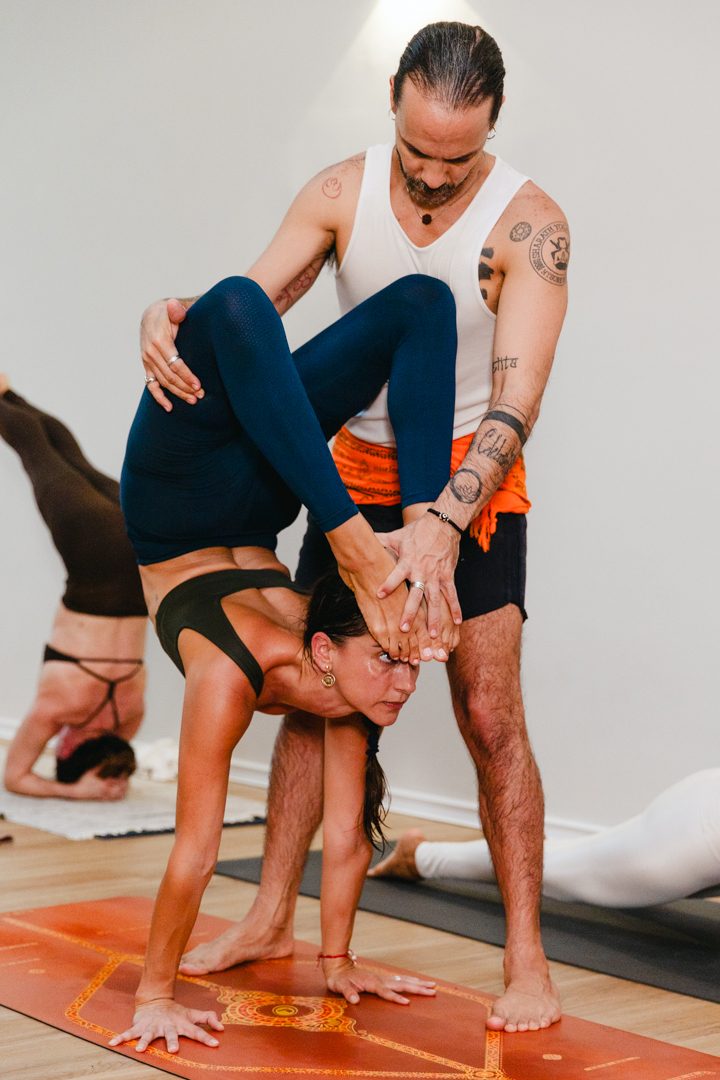
Biomechanics and Respiration
From a biomechanical point of view, transitions act as mechanisms for bodily reorganization. When moving from one asana to the next, the practitioner uses movement to re-establish alignment, redistribute joint loads, and rebalance force vectors. This process is particularly evident in sequences involving Urdhva Mukha Svanasana and Adho Mukha Svanasana, where there is an alternation between spinal extension and flexion, requiring active control of the shoulder and pelvic girdles, in addition to adequate muscle activation.
Breathing synchronized with movement is another central component of these transitions. The coordination between inhalation and exhalation not only organizes the rhythm of the practice but also directly influences the autonomic nervous system, contributing to the regulation of effort and attention. Thus, the transition ceases to be a simple physical displacement and becomes an integrative link between body and breath.
Bandhas and Practice Balance
From an energetic perspective, transitions play a relevant role in the activation and maintenance of the bandhas, especially uddiyana bandha and mula bandha. This activation promotes stability, lightness, and efficiency in movement, in addition to favoring the circulation of energy (prana) throughout the body. The absence of this integration tends to result in heavier, fragmented, and less efficient movements.
Another important aspect is the balance between movement and stillness within the practice. Transitions (vinyasas) represent moments of dynamism associated with the guna Rajas, while holding postures (Sthitih), sustained by stable breathing cycles, relates to the guna Tamas. Consistent practice seeks the harmonization of these aspects towards Sattva, characterized by balance, clarity, and stability.
Complexity is Not Progress
Despite the relevance of transitions, it is fundamental to understand that their complexity should not be taken as an indicator of progress in practice. Elements such as jumps, “floats,” or elaborate passages require time, neuromuscular adaptation, and progressive technical refinement, but they do not constitute the central objective of the method. Let this happen with practice over time. Calmly, respecting the maturation process within the practice.
It is observed, in fact, that experienced practitioners often opt for simpler and economically efficient executions, prioritizing respiratory precision, continuity of movement, and maintenance of the bandhas, to the detriment of performative aspects.
Ultimately, regardless of the degree of complexity of the transitions, the asanas, or the sequence, the quality of the practice is directly related to the ability to sustain mindfulness and conscious breathing. It is this integration that gives coherence, efficiency, and depth to Ashtanga Yoga.
By Lucas Carvalho